- Generative AI Art
- Posts
- OpenAI's Code Red and new 'Garlic' model
OpenAI's Code Red and new 'Garlic' model
PLUS: Anthropic's new Opus 4.5, Google's new AI agents, and a disease-detecting AI from Harvard

Gen AI Art
December 05, 2025 • Estimated Reading Time: 2 minutes
Together with

Competition from Google has reportedly prompted OpenAI to declare a 'Code Red'. The company is now pausing other projects to fast-track a new model, codenamed 'Garlic', in a bid to maintain its leadership position.
The secret model is already showing strong performance in internal tests against top rivals. With the AI landscape shifting so quickly, is this reactive strategy enough for OpenAI to stay on top, or does it reveal a new vulnerability?
Today in AI:
OpenAI's 'Code Red' and secret 'Garlic' model
Anthropic releases Opus 4.5 coding model
A Harvard AI that detects rare diseases
PRESENTED BY GLADLY.AI
Can you scale without chaos?

It's peak season, so volume's about to spike. Most teams either hire temps (expensive) or burn out their people (worse). See what smarter teams do: let AI handle predictable volume so your humans stay great.
What’s new? OpenAI has reportedly declared a 'Code Red' in response to competition from Google, pausing projects to focus on its core AI while secretly fast-tracking a new model codenamed 'Garlic'.
What matters?
The all-hands-on-deck approach comes after Google's Gemini 3.0 topped industry benchmarks, prompting OpenAI to begin pausing non-essential projects like its shopping agent and health tools.
OpenAI's countermove is a new model codenamed 'Garlic', which is performing well in internal tests against both Gemini 3 and Anthropic's Opus 4.5.
This highlights how quickly AI leadership can be challenged, showing that an early lead means little when competitors can rapidly close the gap with a single powerful release.
Why it matters?
This signals an intense acceleration of the AI arms race, forcing top players to innovate at a breakneck pace. For developers and users, this competition will likely produce more powerful tools faster, but it also underscores the need for platform flexibility.
What’s new? Anthropic just released Claude Opus 4.5, its new flagship model that it claims is the world's top AI for coding tasks.
What matters?
The model significantly outperforms competitors in coding, agentic tasks, and computer use, making it a new contender for the best coding model available.
It is also more affordable than its predecessor, Claude Opus 4.1, lowering the barrier for developers and businesses to adopt advanced AI.
The release includes updates to the entire ecosystem, including Claude Code, Claude in Excel/Chrome, and the Developer Platform. See it in action to understand the new capabilities.
Why it matters?
This release intensifies the competition in specialized AI capabilities, particularly in the lucrative coding and developer tool space. By combining higher performance with lower costs, Anthropic is making powerful AI more accessible for automating complex professional workflows.
PRESENTED BY THE YOU.COM
Learn how to make every AI investment count.
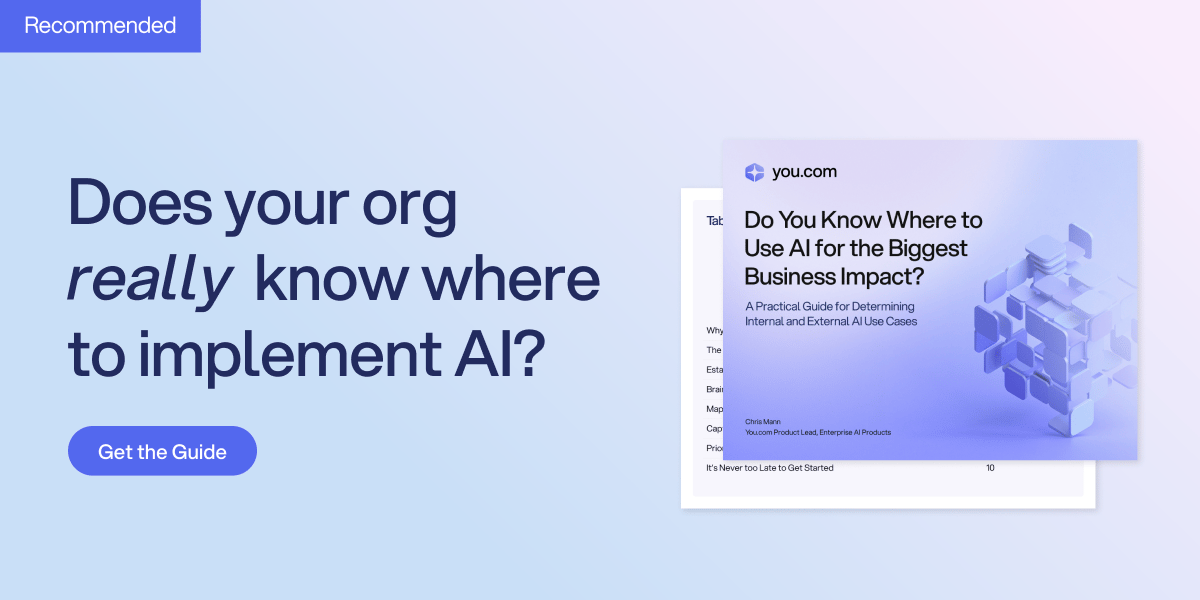
Successful AI transformation starts with deeply understanding your organization’s most critical use cases. We recommend this practical guide from You.com that walks through a proven framework to identify, prioritize, and document high-value AI opportunities.
In this AI Use Case Discovery Guide, you’ll learn how to:
Map internal workflows and customer journeys to pinpoint where AI can drive measurable ROI
Ask the right questions when it comes to AI use cases
Align cross-functional teams and stakeholders for a unified, scalable approach
What’s new? Researchers at Harvard Medical School developed an AI model called PopEVE that excels at identifying the genetic variants behind rare diseases.
What matters?
PopEVE works by pinpointing genetic variants that are most likely to cause a rare disease.
The model already outperforms other leading tools in the space, including Google DeepMind's AlphaMissense.
Harvard's team is now moving the model into clinical settings to test its accuracy in diagnosing real patients.
Why it matters?
Diagnosing rare diseases is often a long, difficult journey for patients and doctors. Tools like PopEVE could drastically shorten that timeline, leading to faster treatments and better outcomes.
Everything else in AI
Anthropic hired law firm Wilson Sonsini to prepare for a potential initial public offering, fueling the race against rival OpenAI to be the first major AI lab to hit the public markets.
Anthropic confirmed the authenticity of its leaked 'Soul' document, an internal guide used for training that details Claude's intended personality, ethics, and self-conception.
OpenAI experiments with a 'confessions' concept where models explain how well they followed instructions, aiming to make their outputs more transparent and easier to validate.
Essential AI Guides - Reading List:
Let us know!
What did you think of today's email?Before you go, please give your feedback to help us improve the content for you! |
Work with us
Reach 100k+ engaged Tech Professionals, Engineers, Managers and decision makers. Join brands like MorningBrew, HubSpot, Prezi, Nike, Ahref, Roku, 1440, Superhuman, and others in showcasing your product to our audience. Get in touch now →